
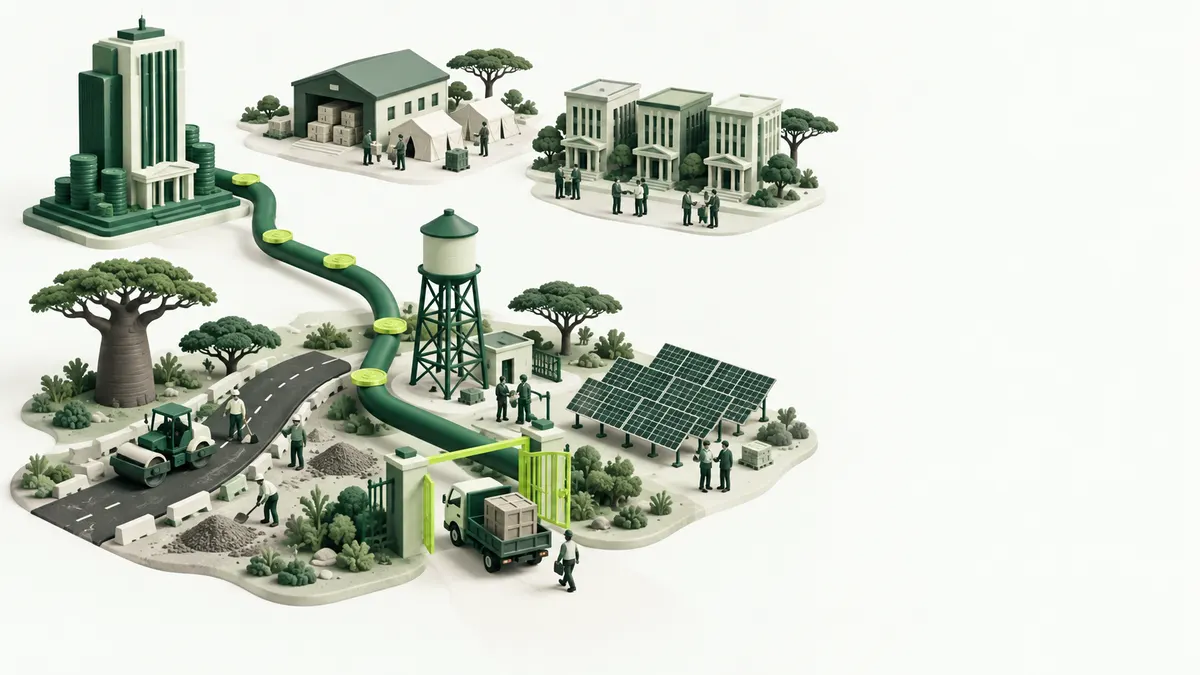
Three publication channels
Before looking for a portal, find out who pays for the contract. The funder sets the eligibility rules, where the notice is published and often its language.
- Multilateral lenders, led by the African Development Bank (AfDB) and the World Bank. The borrowing government runs the procurement, under the lender's rules, and the notice is republished on the lender's website.
- United Nations agencies (UNICEF, UNDP, WFP, UNHCR and others), which buy for their operations across the continent and publish on UNGM or their own portals.
- National portals, where ministries, local authorities and state-owned enterprises publish contracts funded from the national budget.
One project can appear in several channels: a lender-financed water programme is usually advertised on the lender's site and on the borrowing country's portal.
AfDB and the World Bank: project procurement
The AfDB procurement page lists notices for the projects it finances: general procurement notices (GPN), procurement plans, invitations for bids, expressions of interest (EOI) and contract awards. On 24 September 2026 the list held 12,437 documents; that day's notices covered community infrastructure works and water pumps in Mali, audits in Senegal and Mozambique, and digital consultancy in Nigeria. Notices are written in the borrower's language, so French for francophone countries. For goods and works, the AfDB restricts its financing to suppliers from its member countries; the African Development Fund is open to all countries.
The World Bank publishes its project notices in one searchable database. Its contracts follow the Procurement Regulations for IPF Borrowers and are generally open to firms from any country, subject to the exclusions the Regulations set out, such as sanctioned firms. Of the 1,000 most recent notices in its database on 24 September 2026, published over one week, at least 554 concerned an African country or an African regional programme: 281 were in English, 265 in French and 8 in Portuguese.
Two habits pay off here. Track general procurement notices: they announce a project's upcoming contracts, often months before the tender. And read the method: a consultancy EOI leads to a shortlist, while an international competitive tender for works is open to every eligible bidder.
United Nations agencies
UN agencies buy across Africa for humanitarian and development operations: medical supplies, vehicles, shelter, solar power, works and IT services. The shared entry point is UNGM, where supplier registration is free and the basic level is enough for most organisations. Notices state the delivery country, so you can target a specific African market.
National portals
Every country has its own system, language and access conditions. Reference points for the most active markets, checked against official sites:
- South Africa: National Treasury's eTender Publication Portal centralises notices from organs of state. Suppliers register on the Central Supplier Database. The data is published as open OCDS data under a CC BY 4.0 licence: a dated REST API for current releases, and monthly exports for the history.
- Kenya: since July 2025 procurement runs through e-GP Kenya, linked to the regulator's Public Procurement Information Portal (PPRA).
- Nigeria: the Bureau of Public Procurement keeps the federal database of contractors, consultants and service providers, which issues the Interim Registration Report (IRR), and runs the NOCOPO transparency portal.
- Morocco: the Moroccan public procurement portal, run by the Trésorerie Générale du Royaume, publishes notices from the state, local authorities and public bodies. Since decree 2-22-431 of 2023, bids are submitted electronically with an electronic signature certificate.
- Côte d’Ivoire: the Directorate General of Public Procurement runs the SIGOMAP platform, where registration has been required to take part since November 2023.
- Senegal: the public procurement portal, regulated by ARCOP; the Public Procurement Code dates from December 2022.
- Tunisia: TUNEPS, the online public procurement system, with a dedicated registration procedure for foreign suppliers.
- Egypt and Algeria: Egypt's public contracts portal, largely in Arabic, and Algeria's electronic public procurement portal, alongside the BOMOP bulletin and the press.
These portals share neither a format nor a classification. Some publish structured data (South Africa, Kenya, Nigeria); others only web pages or PDFs. A notice can be in English, French, Arabic or Portuguese.
Francophone and anglophone Africa
Anglophone markets (South Africa, Kenya, Nigeria, Ghana) rely on mandatory supplier registers and end-to-end e-procurement portals. The barrier there is prior registration, not language: start it before you find the tender you want, because tax numbers and certificates take time to obtain.
Francophone markets (Morocco, Tunisia, Algeria, Senegal, Côte d’Ivoire and much of West and Central Africa) publish in French, and lender notices for those countries are in French too. Members of the West African Economic and Monetary Union (WAEMU/UEMOA) share a common set of procurement directives, built into national codes such as Senegal's. For English-speaking teams, French is often the real entry cost to half of the continent.
Beyond defence: what gets bought
Most internationally open African public contracts have nothing to do with defence:
- Works and infrastructure: roads, water supply, sanitation, rural electrification and public buildings, the core of lender-financed projects. See construction and infrastructure.
- Digital and IT: government information systems, digital identity, connectivity and management software. See digital and cybersecurity.
- Consulting, studies and audit: consultancy EOIs are among the most frequent notices on lender sites, from project financial audits to technical assistance and feasibility studies.
- Equipment and industry: pumps, generators, medical and laboratory equipment, vehicles. See industry and manufacturing.
- Energy and environment: electrification, climate adaptation and water resilience programmes. See energy and environment.
Bidding: the checkpoints
Before pricing a bid, run each notice through five questions. The bid / no-bid guide covers the general method; this is what changes in Africa.
- Who pays? Lender, agency or national budget: the answer sets the eligibility rules and the complaint route.
- Are you eligible? Member country for the AfDB, no sanctions for the World Bank, national registration for the portals.
- Can you submit? Platform registration, electronic signature certificate, possible physical submission: some prerequisites take weeks.
- Can you deliver? Local presence, subcontractors, bank guarantees, customs clearance, payment currency.
- Do you control language and paperwork? Certified translations, tax and social security certificates, comparable references.
What VIGLIA covers today
VIGLIA monitors more than 200 official sources in more than 60 countries, across six continents. In Africa, the source perimeter it presents includes the national portals of twelve countries: South Africa’s eTender Publication Portal, Morocco’s public procurement portal, the HAICOP public procurement portal in Tunisia, ATTAAT in Libya, the PPDAA supplier-qualification notices in Sudan, GHANEPS in Ghana, the PPCC portal in Liberia, Uganda’s Government Procurement Portal, the PPDAA portal in South Sudan, the DNCMP in the Comoros, the Procurement Oversight Unit in Seychelles and the PRAZ portal in Zimbabwe. World Bank procurement notices, UNGM, AFD-financed tenders published on dgMarket and the tenders of the ICRC, the Norwegian Refugee Council and the Danish Refugee Council are monitored as well.
The eTender Portal is read every six hours through National Treasury’s OCDS releases, over a dated window that can reach back one year; the monthly exports serve only as a historical archive. The portal does not cover every South African buyer: municipalities and state-owned entities are not all obliged to publish there. In Sudan, only supplier qualification notices are read. Each monitored perimeter is agreed with the customer.
The AfDB and the national portals of Côte d’Ivoire, Senegal, Kenya, Nigeria, Egypt and Algeria are not collected by VIGLIA yet. For those channels, the official links above remain the reference.
Where a source is covered, VIGLIA matches each notice against your catalog by reading its content, without relying on CPV codes these notices do not carry, and keeps the link to the original publication.
FAQ
Who can bid on African Development Bank financed contracts?
For goods and works financed from the African Development Bank's own resources, only suppliers from the Bank's member countries are eligible. The Bank has 54 African regional members and non-regional members that include many Western European countries, the United States, Canada, China, India and Japan. Projects financed by the African Development Fund are open to firms from all countries. Check the financing source stated in each notice.
Do I need a local company to bid in Africa?
There is no single rule. World Bank financed contracts are generally open to firms from any country, subject to the exclusions in its Procurement Regulations. National portals usually require registration first: the Central Supplier Database in South Africa, the federal contractor database in Nigeria, an electronic signature certificate in Morocco. A local partner often helps with logistics and follow-up, but the obligation itself is set in each tender document.
Do African tenders use CPV codes?
Rarely. Multilateral lenders and UN agencies do not use CPV, and several national portals classify purchases with their own categories or in free text. Monitoring by CPV code is therefore blind to most of this market: you have to read the title, scope and country of each notice, which is what semantic monitoring does.
Reference sources
Consult the references below and our editorial method. Original documents remain authoritative; a summary does not replace your team's review. Editorial method.
- African Development Bank · procurement notices
- African Development Bank · eligibility requirements
- World Bank · project procurement notices
- World Bank · Procurement Regulations for IPF Borrowers
- UNGM · United Nations procurement notices
- South African National Treasury · eTender Publication Portal
- Morocco Treasury · Moroccan public procurement portal
- Kenya PPRA · PPIP integration with the e-GP system